Today was the first day of the 2008-09 school year at
Rosslyn Academy.
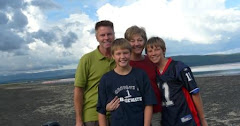
Max, Simon and Tim all had a great first day.
Rosslyn Academy is a private international Christian school.
Its mission is “to inspire and equip each student to develop God-given gifts for Christ-like service in the world community through a quality academic program, a caring committed Christian faculty, and a diverse cross-cultural environment”.
The school began 60 years ago with one teacher and 4 students.
Today there are 515 students in grades K-12 and 120 teachers and support staff.
The 40 acre campus proudly displays flags from each country represented by the students here.
This year there are 37 flags.
Max is the only Canadian in his class.
Simon sits between a boy from
Belgium and a Japanese boy.


Max is in grade 5 and his teacher is Mr. Kranik.
Simon is in grade 3 and his teacher is Miss Winter.
It looks like they are both going to enjoy the year, although the expectation for homework has everyone (especially mom) a little worried.
Simon is nearly as tall as his teacher!
Yesterday we all attended an orientation for new students – the auditorium was full!
As parents, we were asked to sign a “Statement of Support” indicating a commitment to the mission, policies, and practices of the school.
We learned about the hot lunch program, music lessons, band and choir, intramurals, Spiritual Emphasis Week, weekly Chapel classes, and the upcoming Parent-Teacher Fellowship picnic and Open House.
We are all excited about the expertise available to the students; they have special teachers for Art, Science, Bible class, Swahili, and Phys Ed.
Classes start at 8:30 each morning.
The boys have a 15 minute snack/ recess in the morning, 45 minutes for lunch, and a 15 minute recess in the afternoon.
The day finishes at 3:30 except for intramurals on Mondays.

Tim is enjoying his new role as Middle School Principal.
He will be teaching a grade 7 class of Christian Religious Education.
He has a great Leadership Team and seems to be having quite a bit of fun!
Today he learned how to turn on the generator on lower campus – right up his alley!
Stephanie Weeks is the Elementary School Principal and this is her first day of school too.

This morning there was a school-wide worship time and assembly.
One of the chaplains prayed a blessing over the students and teachers.


 Tim is enjoying his new role as Middle School Principal. He will be teaching a grade 7 class of Christian Religious Education. He has a great Leadership Team and seems to be having quite a bit of fun! Today he learned how to turn on the generator on lower campus – right up his alley! Stephanie Weeks is the Elementary School Principal and this is her first day of school too.